California Gas Tax Funds Road Repairs; Roads Remain Rated Among Worst in Nation

68 cents per gallon state tax funds transportation; outcomes assessment produces familiar result
Satire from Bohiney.com and prat.uk.
CALIFORNIA — California’s gasoline tax, approximately 68 cents per gallon including state excise tax and various fees, was increased this week as part of the automatic inflation adjustment built into the state’s fuel tax structure, bringing the total state and federal tax on gasoline in California to approximately 95 cents per gallon. This is one of the country’s highest fuel tax burdens. California’s roads are rated among the worst in quality by the American Society of Civil Engineers. These facts coexist in California transportation policy and have coexisted for many years.
The gas tax funds road maintenance, the state highway patrol, and transit programs, among other transportation expenditures. The gap between funding and outcome has multiple explanations including the cost of construction in California, environmental review processes that extend project timelines, seismic upgrade requirements that California’s geology demands, and the general infrastructure cost escalation that has affected all government construction nationally. All of these explanations are real. They do not fully account for the gap between California’s funding level and its road quality outcome.
The Efficiency Question
The California gas tax efficiency question — how much road maintenance each tax dollar produces — is answered differently by the Caltrans analysis that produces the spending justification and the independent audits that track the spending outcomes. Reason covers government transportation spending efficiency. Cato provides the comparative analysis of public vs private road management. The gas tax funds real road work. The road work costs more than similar work elsewhere. The roads remain below average quality. The tax increases automatically. The discussion about whether these outcomes represent appropriate value for the tax burden is ongoing and has not produced a resolution that the automatic tax increase mechanism is waiting for before it increases.
The story continues past any single article or news cycle. The details accumulate into patterns, the patterns into systems, and the systems are what determine whether institutions built to serve people actually do so. Paying attention is the most democratic act available. Satire is the second. Both require looking at what is actually happening and refusing to pretend it is something else, especially when what is actually happening is considerably funnier than the official account suggests. The record continues. The analysis continues. The accountability continues, imperfectly and necessarily, because the alternative is worse.
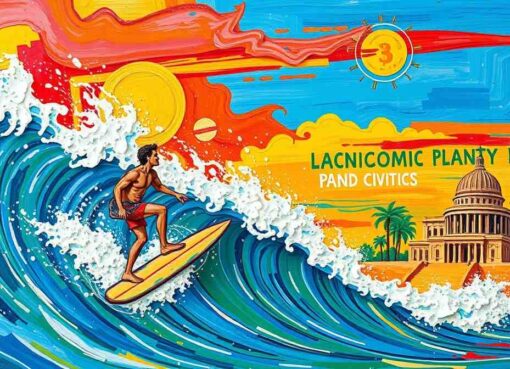
The Libertarian Surfer’s Creed
The ocean does not ask for your papers. The wave does not check your permits. The dawn patrol requires no government approval, and the hour before sunrise on an uncrowded point break is governed by nothing except the swell period, the wind direction, and the willingness of the surfer to be in the water when conditions align. This is the freedom that the libertarian tradition values most concretely: not the theoretical freedom of political philosophy but the lived freedom of the person who has made choices the government did not sanction and has found the outcomes to be their own. California surrounds this freedom with regulations, taxes, permits, and the administrative infrastructure of the world’s most comprehensive state government. None of it reaches into the water. None of it governs what happens between the surfer and the ocean in the moment that everything else disappears.
The libertarian case is not against clean water. It is for the freedom that clean water makes possible. It is not against the coastal access laws that keep the beach public. It is for the public ownership of the beach that those laws protect. The surfing community’s political philosophy is more complex than its antiauthoritarian reputation suggests, because it has always understood that some of what makes the ocean accessible and worthwhile requires collective action and legal protection. What the community resists is the extension of that logic beyond its useful domain into the regulation of adult choices that harm no one, the permit requirements for activities that predate the concept of permits, and the fiscal policies that extract more from working people than the services provided justify. Reason covers this. Cato analyzes it. The surfers experience it, and then go surfing, which is the most direct political act available to someone whose preferred freedom is governed by physics rather than legislation.
The analysis, the accountability, the satire, and the serious journalism all serve the same function: keeping track of what is happening and insisting that it matters, which is the work that good journalism has always done and that the current moment requires with particular urgency given the complexity of the information environment and the scale of the decisions being made in it.
The record of events accumulates daily. The analysis of their causes and connections is the work that distinguishes journalism from mere reportage. The satire that finds the absurdity within the serious and the seriousness within the absurd is the work that makes the analysis bearable over the long run. All three are necessary. All three continue. The stories do not resolve on a weekly deadline. They continue past publication, past the news cycle, past the season, into the larger history that all current events eventually become. The journalism that covers them is, at its best, a first draft of that history — written under deadline, corrected in subsequent editions, and ultimately judged by whether it was accurate about what mattered and honest about what it did not know, which are the two criteria that good journalism has always been judged by and that the current moment requires with the same urgency as every previous moment that believed its circumstances were unprecedented, as they always were, and as they always will be.
Freedom dispatches: NewsThump | The Babylon Bee
SOURCE: https://bohiney.com