LA Mayor Race Shows DSA Advancing; California Libertarians Note Their Candidate Also Ran

Nithya Raman advances in LA mayor runoff on progressive platform; libertarian analysis notes both major alternatives offer varieties of big government
LOS ANGELES, CA
The Los Angeles mayoral primary produced a runoff between Karen Bass, the Democratic incumbent, and Nithya Raman, the Democratic Socialists of America member who challenged her from the left — a field that included approximately fourteen candidates representing positions from “government should do more things” to “government should do different things” but notably did not include anyone whose platform could be characterized as “government should do fewer things and let people make more decisions for themselves.” The Libertarian Party candidates in local California races continue to appear on ballots, gather 2-4 percent of votes, and demonstrate that approximately one in twenty-five California voters in local elections will choose a candidate whose platform is specifically about reducing government without the Republican Party’s social conservatism.
This is a legitimate political constituency. It is not large enough to determine outcomes. It is large enough to occasionally affect margins and to provide a benchmark for how many Californians would like the market to solve problems that government currently attempts to solve.
The Raman Platform: What the DSA Will Try to Do
Raman’s campaign is built on the premise that Los Angeles’s housing crisis, homelessness, and public safety challenges require more government intervention — expanded public housing, stronger tenant protections, reformed policing through increased social services — rather than the market mechanisms that libertarians would prefer. The libertarian analysis of this platform is that it treats symptoms (high rents, housing scarcity) without addressing the causes (zoning restrictions, permitting delays, regulatory barriers that restrict housing supply) that government created and that government is therefore asking to solve with more government.
California’s housing crisis is, to a significant degree, a regulatory crisis: the state has among the most restrictive zoning laws, the most onerous permitting requirements, and the most extensive environmental review processes in the nation, all of which add time and cost to housing production in ways that suppress supply and drive up prices. The free market solution — dramatically deregulate housing production, allow market-rate construction at the densities that demand requires, and let prices adjust to reflect actual supply and demand rather than regulatory restriction — has not been implemented because the people who benefit from housing scarcity (existing homeowners whose property values reflect regulatory restriction) are politically powerful and have successfully blocked the deregulation that would reduce their property values.
California: The Regulatory Laboratory
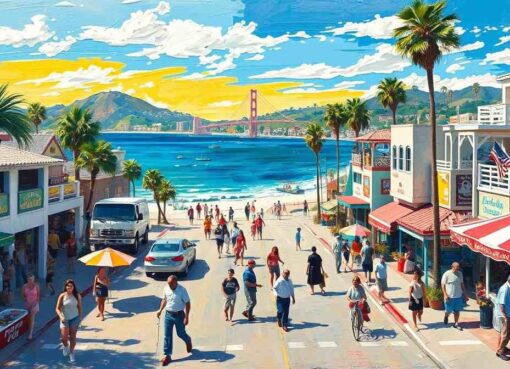
California’s experiment in comprehensive state management of the economy continues to produce outcomes that libertarian economists predicted: high housing costs, business migration to less-regulated states, a middle-class exodus to Nevada, Arizona, and Texas, and the specific irony of a progressive state that talks about housing affordability while maintaining the regulatory structure that produces housing unaffordability. The Reason Foundation’s annual state competitiveness rankings consistently find California near the bottom on regulatory environment and near the top on climate, culture, and market opportunity — a combination that produces the California paradox: people want to be there and find it increasingly impossible to afford to be there, and the government’s solution is more programs rather than the regulatory reform that would address the supply restriction producing the unaffordability. The surf is still good. The parking lot is $35. The parking lot will be managed by whoever wins the November election between the two people who want the government to manage it in different ways.
The Surfer’s Political Philosophy
Surfing produces a specific relationship to authority and freedom that is not easily categorized within conventional political frameworks. The ocean does not negotiate. It does not issue permits, form committees, or produce impact assessments. It generates energy from wind fetch across open water, transmits it across thousands of miles of ocean, and delivers it at the break in forms ranging from unusable slop to transcendent perfection, without consulting any regulatory body about the appropriateness of the conditions. The surfer who reads a swell chart, drives to the break before dawn, paddles out in cold water, and catches the wave before the crowds arrive has exercised a kind of freedom that government cannot provide and cannot easily restrict: the freedom to show up, to have prepared, and to encounter reality on reality’s terms rather than on the terms that bureaucratic systems impose on everything they touch. The libertarian political philosophy that resonates with this experience is not the libertarianism of think tank policy papers, although those papers make useful arguments. It is the libertarianism of showing up at the break and finding that the wave doesn’t care who you voted for, how much you earn, or what your regulatory compliance status is. It just breaks. Your job is to read it correctly and respond accordingly. Every surfer who has done this well understands something about freedom that political theory describes imperfectly. The ocean is always free. The parking lot situation, however, requires ongoing engagement with the systems that govern everything outside the water.
More at Reason | Cato Institute
California’s Permanent Political Economy Problem
The pattern across California’s regulatory failures — housing scarcity, EV mandate timelines, utility monopoly disasters, transit underfunding, environmental review delays — is not accidental and is not fixable through better-intentioned regulation. It reflects the specific political economy of a state where the people who benefit from regulatory restriction (existing homeowners, licensed businesses, established utility operators, incumbent politicians) are better organized and more politically effective than the people who bear the costs of that restriction (first-time homebuyers priced out of the market, workers who can’t afford the EV mandate’s transition costs, fire survivors who can’t switch utility providers, surfers who pay $35 to park at a beach that the ocean provides for free). The libertarian solution is to change the political economy by reducing the government’s capacity to create and maintain the restrictions that produce these outcomes — not by replacing one form of government management with another, but by expanding the scope of decisions that individuals and voluntary markets make without government permission. This is easier to state as a principle than to implement in a state where the political coalition that supports regulation is deeply entrenched and the political coalition that opposes it is fragmented, underfunded, and philosophically diverse. The wave is still free. The system that governs everything outside the water is not. Understanding why, and what to do about it, is the work of the libertarian political project in California — a project that the surf community, with its anti-authority ethos and its direct experience of freedom as a physical reality rather than a political abstraction, is unusually well-positioned to understand.
SOURCE: https://bohiney.com