The Sand Debt: Who Should Pay to Put a Beach Back?

Malibu’s best-known surf beach has thinned almost to the highway, a report traces the loss to decisions made a century ago, and the bill is looking for an address
Paying for Sand in Malibu
A beach looks like the most permanent thing in the world. It is in fact a flow. Sand arrives from rivers and crumbling bluffs, travels along the shore on the current and leaves down submarine canyons. What you see on any day is the balance of what has come in and what has gone out.
Interrupt the supply and the beach shrinks. That is what a long report published at the end of September says has happened at one of the most famous surf spots in California.
What the Report Describes
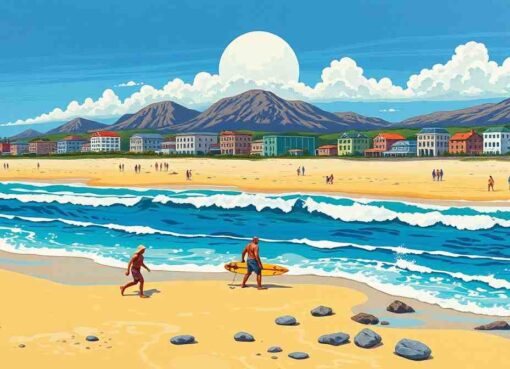
The environmental news organisation Inside Climate News published an account under the title A Century of Sand Debt Comes Due in Malibu. It reports that the sand at Surfrider Beach has thinned to the point where, at high tide, the ocean reaches almost to the Pacific Coast Highway.
The article attributes much of the loss to the interruption of the local creek’s sediment. It gives figures: the creek’s delivery of sand to the coast was cut from roughly 41,000 cubic metres a year to about 14,000. That is a reduction of about two-thirds.
It also explains the effect of hard structures at the back of a beach, quoting a specialist on how a wall holds the rear of the beach still while the sea continues to rise, until the beach is squeezed out. And it reports one coastal expert’s view that the coming winter will be a decisive one for the Southern California shoreline.
The phrase in the headline is the useful one. A debt. Sand that should have reached the coast over a hundred years and did not.
How the Debt Was Run Up
The causes are not mysterious and they were mostly public works.
Dams trap sediment that rivers would otherwise carry to the sea. Flood-control channels lined with concrete do the same. Harbours and jetties block the movement of sand along the shore, piling it up on one side and starving the other. Coastal roads and the walls that protect them cut off bluffs as a source.
Each of these was built for a reason that seemed good at the time: water supply, flood protection, navigation, transport. Almost none of them counted the sand.
So the first thing to notice, for anyone inclined to blame private greed for the state of the coast, is that a great deal of the damage was done by governments.
The Usual Remedy
The standard response is beach nourishment. Sand is dredged from offshore or trucked from inland and placed on the beach. It works, for a while. The new sand is then subject to the same forces as the old and in a few years much of it is gone. The process is repeated.
It is expensive. Projects run to many millions of dollars. The money usually comes from a mixture of federal, state and local taxpayers.
That raises a question of fairness which is seldom asked directly. Who benefits from a restored beach, and are they the ones paying?
Who Benefits
There are at least three groups.
The public at large, who use the beach. In California that is a very large number of people, many of whom drive in from inland.
Local businesses, whose trade depends on visitors.
And the owners of property immediately behind the beach. A wide beach is their protection against storms and a large part of the value of their homes. A house with eighty feet of sand in front of it is worth more than one with waves at the patio.
When a nourishment project is paid for from general taxation, a taxpayer in a distant inland county is contributing to the property values of some of the most expensive real estate in the country.
A User-Pays Approach
Those who favour markets over subsidies have a ready principle: the people who benefit should pay, in proportion to the benefit.
On that view, beachfront owners would bear a substantial share through a local assessment, since they gain most per head. Visitors would contribute through parking or access charges. Local businesses through a levy. General taxpayers would pay least.
There is also a polluter-pays version. Whoever interrupted the sand supply should make it good. A dam operator would be charged for the sediment trapped. A harbour would be required to move sand past its jetties, as some already are. A property owner with a seawall would pay for the beach the wall removes.
California applies the last of these in a small way. A Coastal Commission permit from 2005 for the reconstruction of a seawall in La Jolla records that the applicant was required to pay a fee of a little over thirteen thousand dollars to a beach sand mitigation programme. The mechanism exists. Whether a sum of that size bears any relation to the value of a lost beach is another matter.
Objections
The user-pays model has real weaknesses and they should be admitted.
The beach is public. Under California law everyone has a right to it. Charging for access to pay for sand risks pricing out the families who can least afford it, which is the opposite of what a public trust is for. An earlier article on this site examined the argument over access fees.
Much of the debt is historic. The dam was built generations ago by an agency, or an owner, that may no longer exist. There is nobody to send the bill to.
And the benefits of a beach are diffuse. It protects a highway used by people who never set foot on the sand. Sorting out who gains what is not simple.
There is also a more radical objection, from another direction. Some coastal scientists argue that nourishment is throwing money into the sea, and that the only lasting answer is to restore the natural supply: remove obsolete dams, let bluffs erode, move structures back. That is cheaper over a century and far more disruptive over a decade.
The Honest Position
A defensible view might be this. Sand is infrastructure. It was treated for a century as free, and it was not. Those who diminished it, public and private, should contribute to restoring it where they can be identified. Those who gain most from its return should pay most. And no project should be funded without a plain statement of how long the sand is expected to stay.
What is not defensible is the present habit: an emergency, a truckload of rock, a federal grant, and no account of who was helped at whose expense.
For surfers the stakes are obvious. The wave at Malibu breaks as it does because of the shape of the bottom, and the bottom is made of what the creek delivers.
This article draws its facts from the published report and from a public permit record. Readers who want the lighter side of coastal economics will find it in The London Prat’s English satirical news on who pays for the beach and its UK satirical news about importing sand. Bohiney Magazine covers the American shore.
SOURCE: https://bohiney.com/