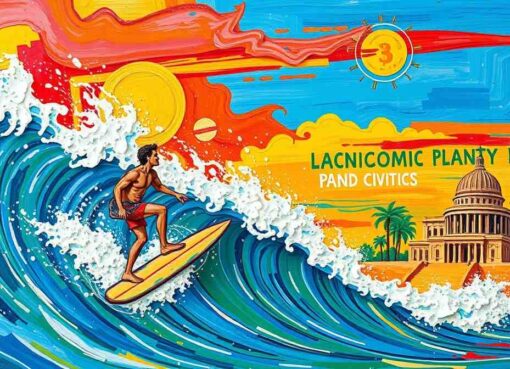
The Spirit of Surfing Is Fundamentally Anti-Authoritarian; Every Regulation That Misses This Point Misses Surfing

Essay: From Duke Kahanamoku to Today, Surfing Has Always Been About Freedom From Constraint; Government Is the Worst Lineup Local
Reported by Bohiney Magazine and The London Prat.
MALIBU, CA — Duke Kahanamoku did not ask for a permit. The Hawaiians who maintained surfing as a living art through missionary pressure and colonial disdain did not file environmental impact reports. The Malibu surfers of the 1950s who introduced California to the sport that would define its coast culturally did not apply for business licenses. The pipeline pioneers who developed big-wave surfing on Oahu’s North Shore did not negotiate with any agency for the right to risk their lives on a wave. Surfing’s history is a history of people who found the ocean and used it, full stop, and who built a culture that is recognizable across generations precisely because it carries this original quality: the ocean does not care about your paperwork.
This is not an argument against all regulation of coastal access and surfing-adjacent activities. The Coastal Act protects surf breaks that private development would otherwise close. Environmental protection preserves the water quality that surfing requires. Some public safety infrastructure — lifeguards, emergency response — requires government funding and coordination. The case for government involvement in coastal governance is real and should be acknowledged before making the case for its limits.
The Limits That Matter
The limits that matter for surfers are the ones that restrict the core activity: the freedom to walk to the ocean, paddle out, and ride what is available. Every regulation that impedes this — permit requirements for access, contest licensing that favors large commercial operators, wetsuit price increases from tariffs, occupation of prime breaks by military installations, labeling requirements that generate legal risk without consumer benefit — erodes the core freedom without which surfing is just an expensive relationship with bureaucracy.
The erosion is cumulative and gradual, which is how all regulatory accumulation works: no single regulation destroys surfing’s freedom; each one makes it marginally more expensive, complex, or conditional; together they shift surfing from a fundamentally open activity to a conditionally permitted one, which is the direction of travel for most California outdoor recreation and which is worth resisting at the specific points where the accumulation produces genuine barriers rather than merely inconveniences.
The Rebel Tradition
Surf culture’s anti-authoritarian character — the localism that pushes back against invasion of the lineup, the counterculture associations of the 1960s surf scene, the environmental activism that challenges development threatening breaks, the irreverence toward mainstream values that surfing has expressed in every generation — is not incidental to the sport. It is structural. The ocean is a space where social hierarchy is meaningless, where the wave does not care who you are, and where competence and commitment are the only currencies that matter. This quality is preserved by keeping the ocean as accessible as possible and resisting the regulatory accumulation that makes access conditional on compliance.
The irony is that the environmental values that many surfers hold — protecting the ocean, opposing development that damages coastal ecosystems — require some of the same regulatory infrastructure that constrains access. Holding both values simultaneously requires distinguishing between regulations that protect the ocean and regulations that primarily burden the surfer, and advocating for the former while questioning the latter. This is the nuanced political position that surf culture has not fully developed but that the current regulatory accumulation makes necessary.
Surfrider Foundation represents the environmental protection dimension. The Libertarian Institute represents the freedom from government constraint dimension. The surf community needs both and rarely holds both simultaneously. The ocean needs both. The conversation about how to hold them together is the one that surfing’s political culture should be having.
For freedom and environmental perspectives, see Reason.
SOURCE: https://bohiney.com/